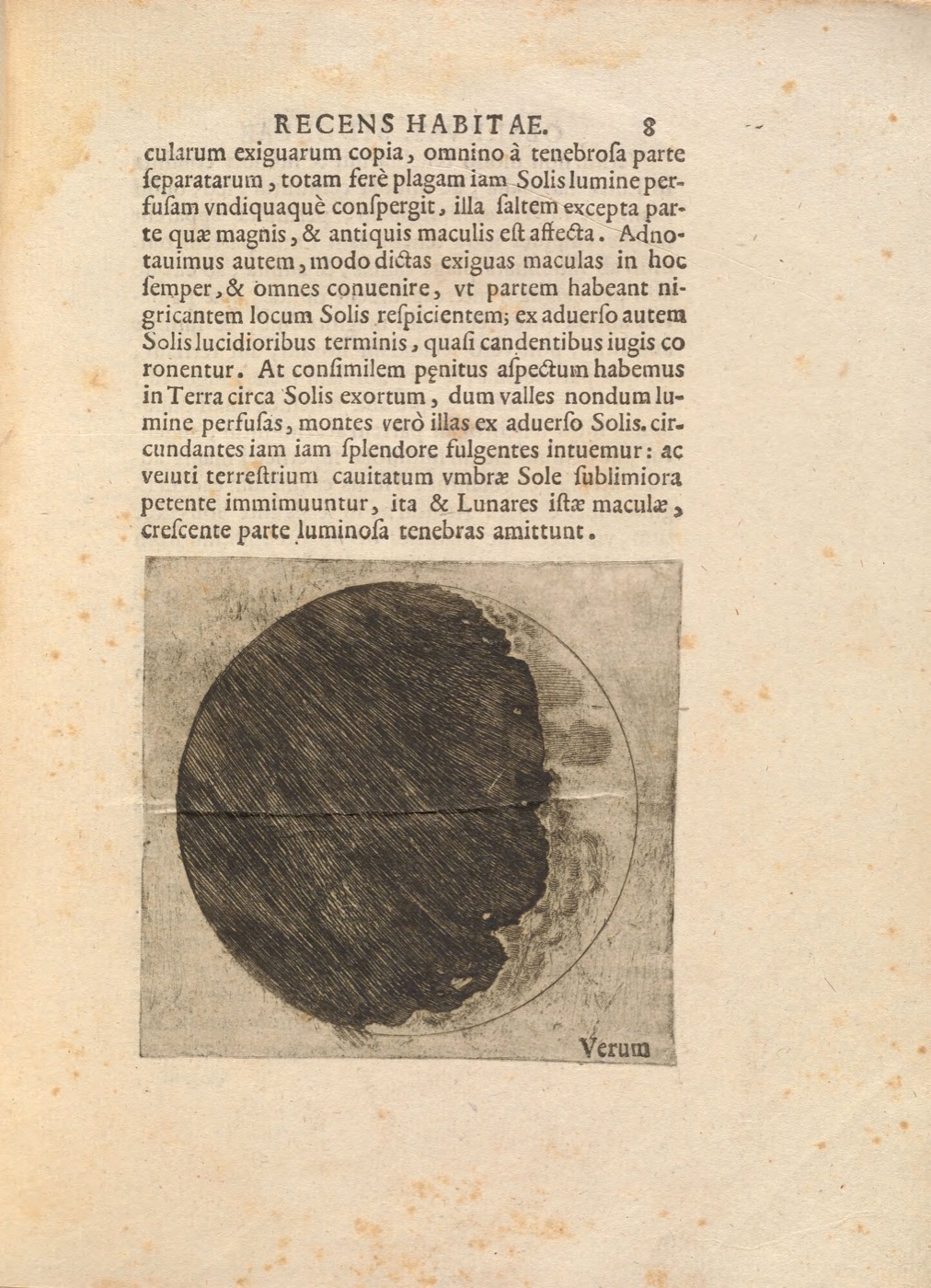
“Now we have an appearance quite similar on the Earth about sunrise, when we behold the valleys, not yet flooded with light, but the mountains surrounding them on the side opposite to the Sun already ablaze with the splendour of his beams …”
From the same book. The Latin of these lines is printed just above the picture. Translated by Edward Stafford Carlos, 1880.
The Linda Hall Library dates the modern picture of the moon to the evening of 30 November 1609. That night in Padua, Galileo turned his telescope on the moon and saw that its edge of light was uneven. He made at least five more drawings over the next eighteen days, and chose some of them to be engraved.
Albert Van Helden, of Rice University's Galileo Project, explains how he read the dark lines. They moved as the angle of the sunlight changed, so he took them for shadows of mountains and valleys. Van Helden adds that the English astronomer Thomas Harriot drew the moon through a telescope first, but never published his drawings.
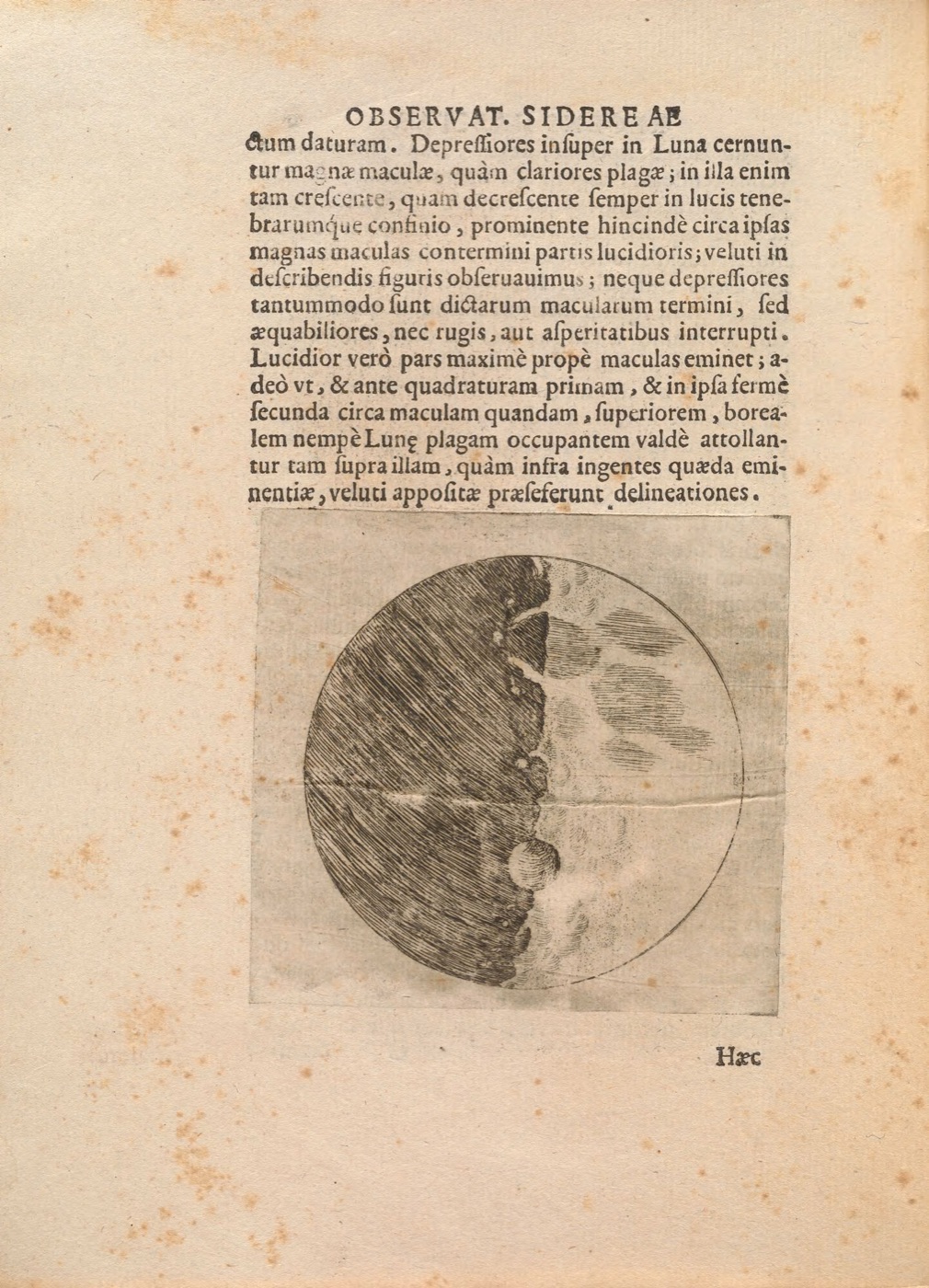
“… the Moon certainly does not possess a smooth and polished surface, but one rough and uneven, and, just like the face of the Earth itself, is everywhere full of vast protuberances, deep chasms, and sinuosities.”
From the opening of the same book. Translated by Edward Stafford Carlos, 1880.
The Linda Hall Library says the large round crater near the bottom is probably the one now called Albategnius. It is drawn much larger than it really is. The library reads its size as a sign of how strongly it struck him.
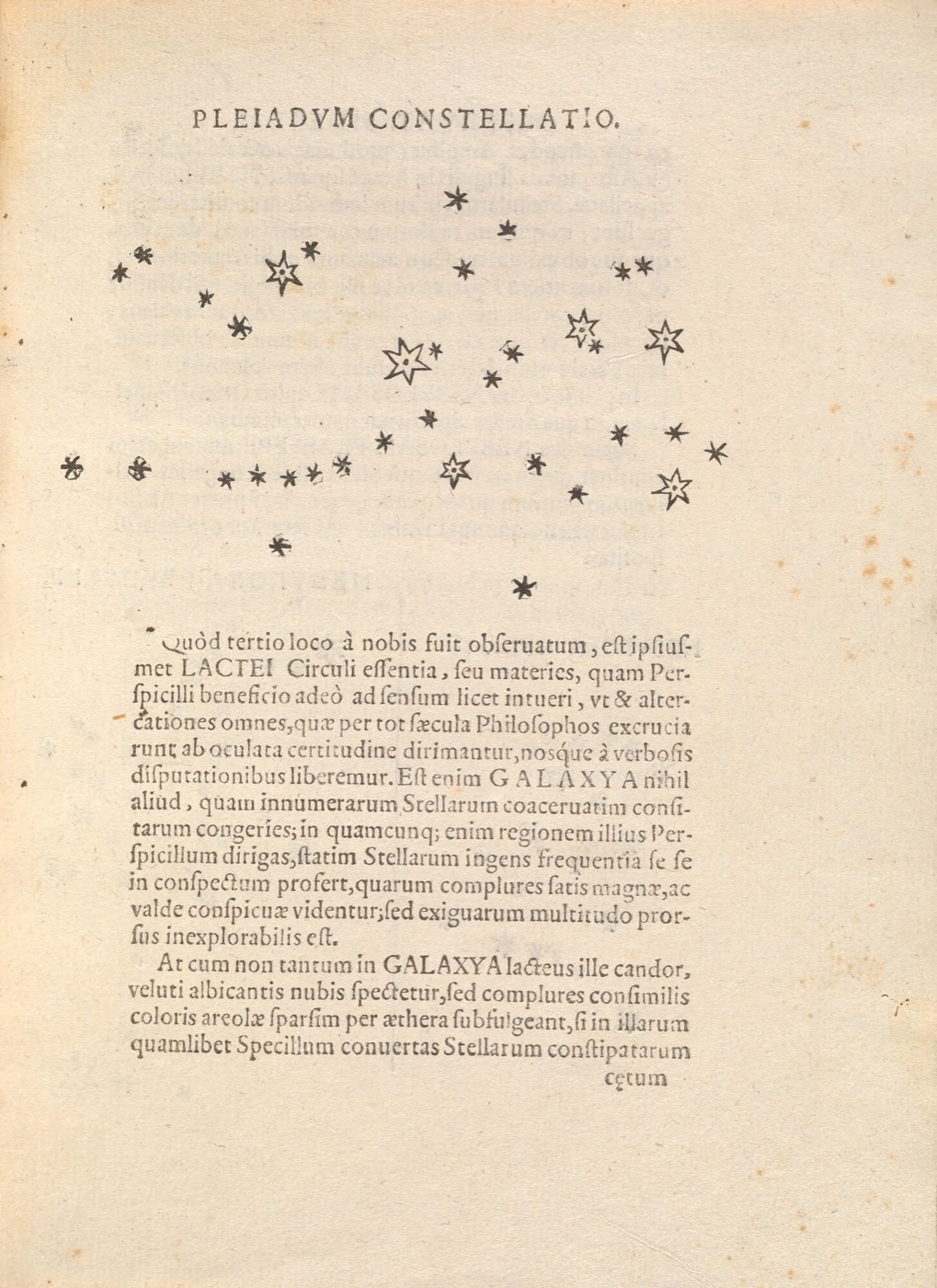
“Near these there lie more than forty others invisible to the naked eye, no one of which is much more than half a degree off any of the aforesaid six; of these I have noticed only thirty-six in my diagram.”
From the same book, on the six stars of the Pleiades that the eye can see. Translated by Edward Stafford Carlos, 1880.
The American Institute of Physics says his telescope showed crowds of stars where the eye saw few. The stars no longer looked like one fixed shell. They seemed to go on outward, perhaps without end.
The same institute says the telescope helped move trust in what we know about nature “from men to instruments”.
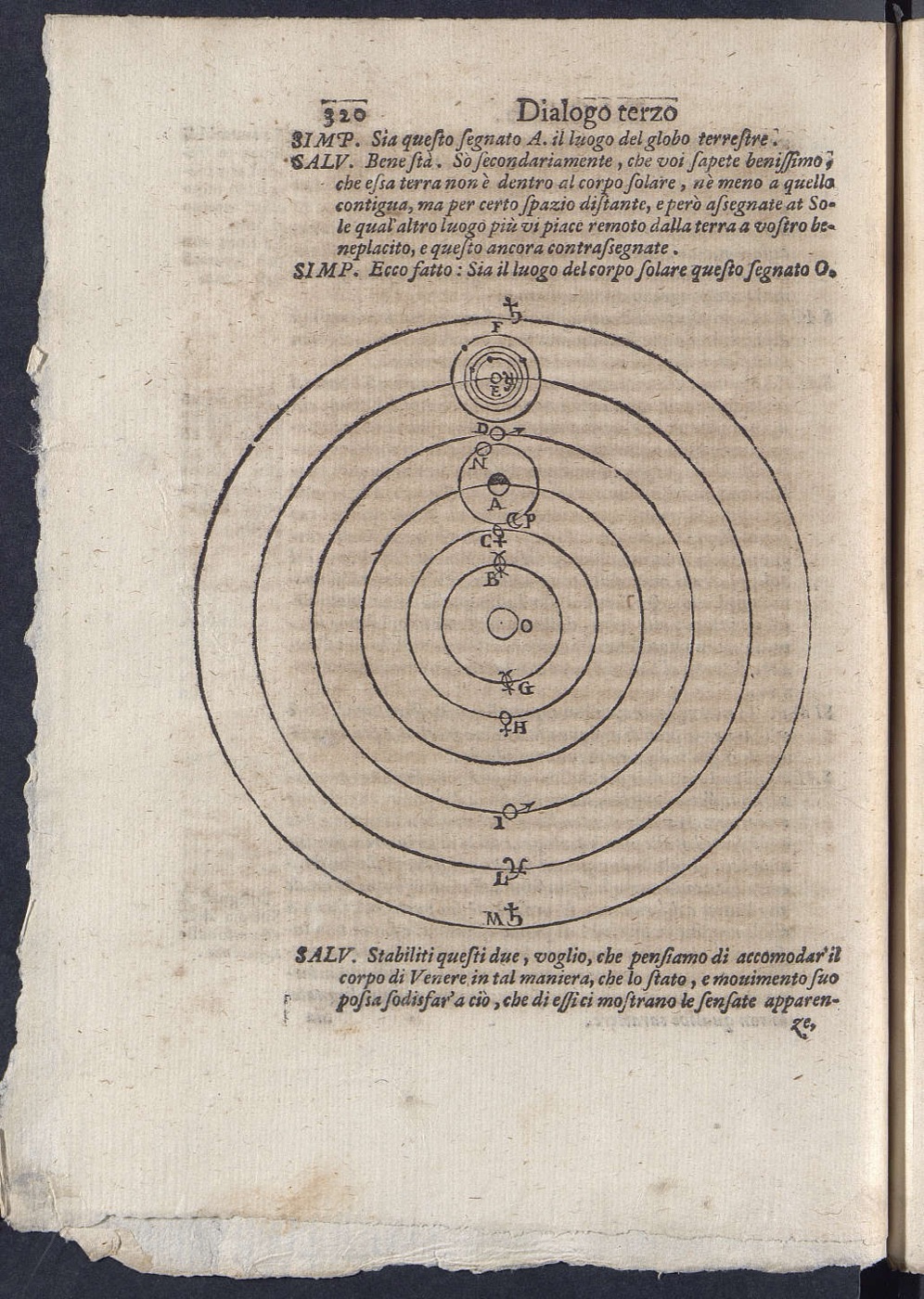
The book is a conversation between characters. On this page, Salviati, who speaks for Galileo's view, asks Simplicio, who holds the old view, to mark the earth. Simplicio marks it A. He then places the sun at some distance and marks it O. Salviati asks him next to place Venus so that it fits what the eye really sees. In plain words, from the Third Day of the Dialogue, on the page shown.
David Marshall Miller, in the Stanford Encyclopedia of Philosophy, says Simplicio builds this diagram from what can be observed. Venus has phases, and Venus and Mercury never stray far from the sun. The finished drawing matches the Copernican system, with the sun at the centre.
Not everyone has read it the same way. Its title page says it gives the reasons for both systems without deciding. Miller says it “clearly, though not explicitly, favors” the sun-centred one. The Inquisition banned its sale soon after it came out. In June 1633 Galileo was convicted.
The book he finished in the dark
Condemned, confined to his villa outside Florence for the rest of his life, grieving the daughter who had held him up, and going blind, Galileo spent those years finishing the book that outlasted all of it.
The books of Galileo Galilei
Six works by the man who pointed a telescope upward and reported what was there: quick reports, sharp arguments, a letter on faith and science, the dialogue that put him on trial, and the book he wrote under house arrest.
The letters about going blind
Two short pieces from letters Galileo wrote to a friend as his sight failed, the second after he could no longer see at all. Then the same words in plain English.
The letter about his daughter's death
Part of a letter Galileo wrote to a friend a few months after his daughter, Sister Maria Celeste, died. Then the same words in plain English.
The passage on a very new science
The opening of the part of his last book that deals with motion, written while he was confined to his house. Then the same words in plain English.
Here's a guy who got in serious trouble for the radical act of... Looking. Galileo built a better telescope, turned it upward at night, and reported what was actually there.
What was there broke the official story. Moons going around Jupiter — so not everything orbits Earth. The phases of Venus — so Venus orbits the sun. The Earth wasn't the centre of everything. Copernicus's sun-centred picture suddenly looked far more believable.
The Church told him to stop. He didn't, really. So they tried him, made him publicly take it back, and locked him in his house for the rest of his life. The story goes that as he rose from recanting he muttered 'and yet it moves.' True or not, it's the perfect line — reality doesn't care what you're forced to say about it.
That's why he matters when you're lost. He's the patron saint of 'look for yourself.' Don't take the handed-down version. Go see. The universe is more honest than the people explaining it to you.
Sources
- Britannica — Galileo
- Stanford Encyclopedia of Philosophy — Galileo Galilei
- Galileo Galilei — biography