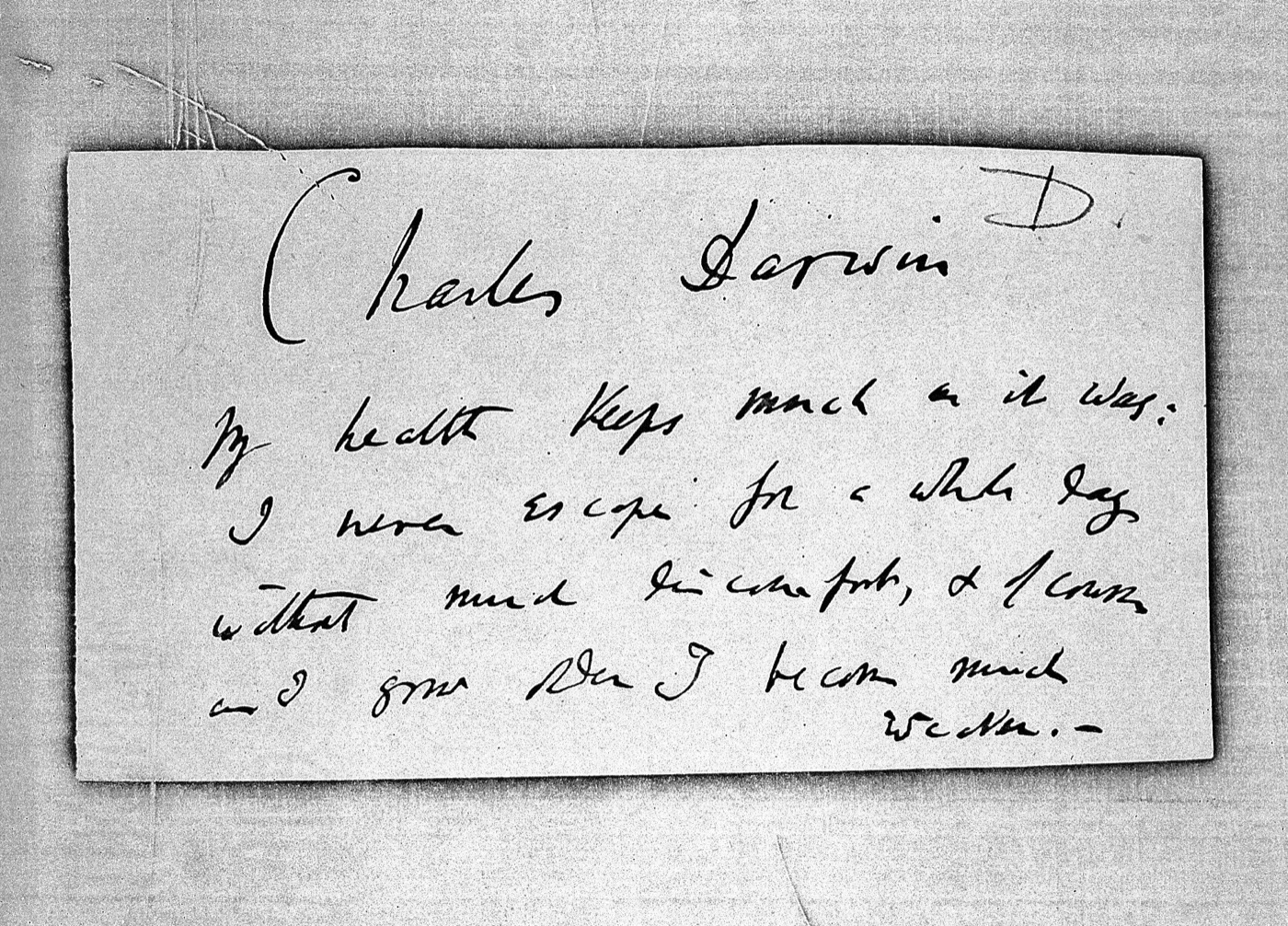
The Darwin Correspondence Project, at the University of Cambridge, says he was ill on and off for most of his adult life. He had stomach trouble, vomiting, headaches and tiredness.
No one agrees on the cause. The Project lists many ideas, among them Chagas disease caught on the Beagle voyage, and causes of the mind. It does not choose one. It also notes that his illness kept him at home in Down, where he had more time for his work.
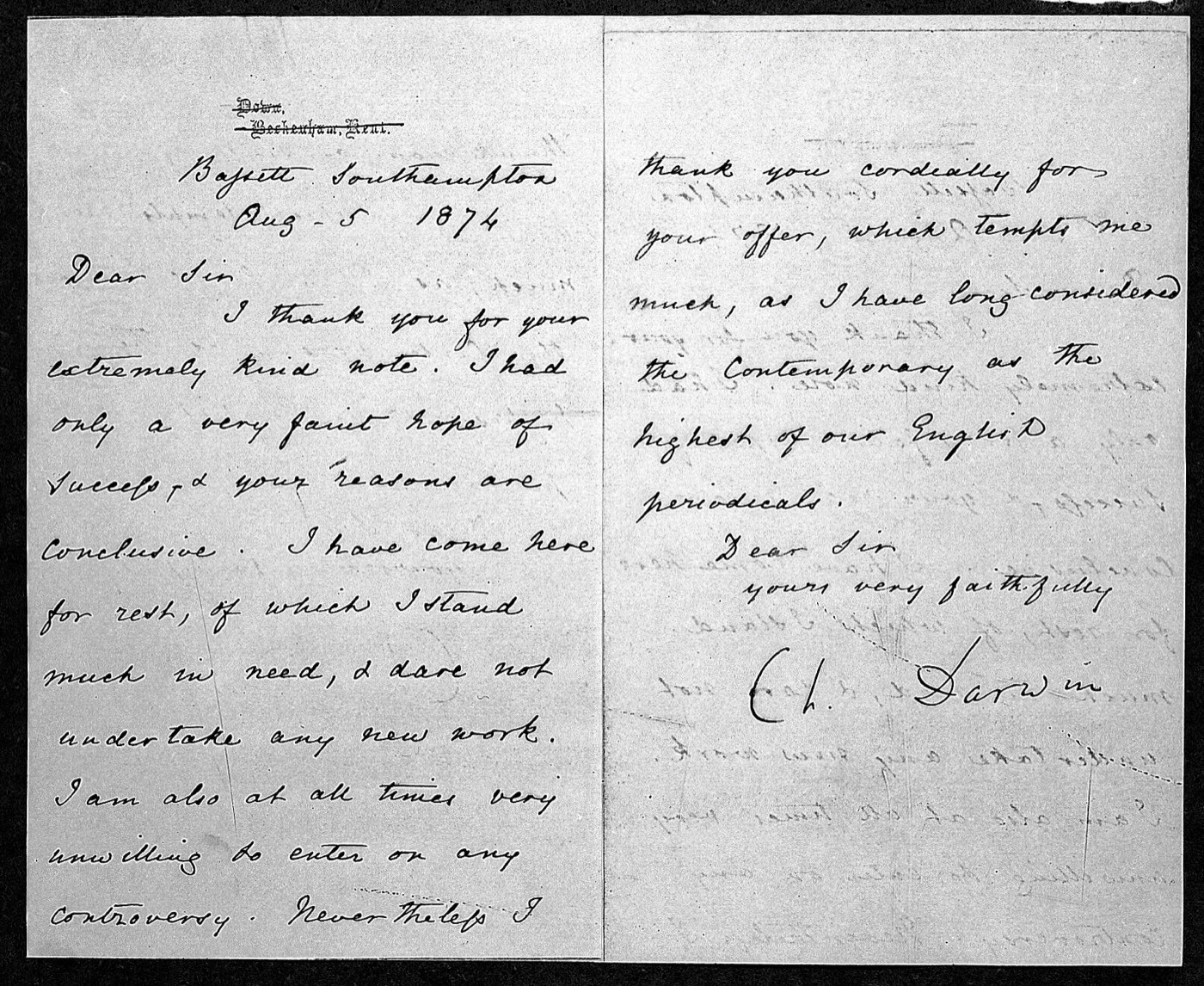
“I have come here for rest, of which I stand much in need, & dare not undertake any new work. I am also at all times very unwilling to enter on any controversy.”
From the letter shown here, to James Knowles, editor of the Contemporary Review.
The Darwin Correspondence Project explains what came before. An unsigned review had mocked what he wrote about language. The Project names its writer as St George Jackson Mivart.
Darwin asked Knowles to reprint an article on language by the American scholar William Dwight Whitney, which answered the views of Max Müller. Knowles said no, and asked Darwin to write a reply himself. This letter is his answer.
“I hope that I may be excused for entering on these personal details, as I give them to show that I have not been hasty in coming to a decision.”
From the first page of the book's introduction, 1859.
On the same page he wrote that he began on the question in 1837. He also wrote that his health was far from strong, and that he had been urged to publish this shorter version. In plain words, from page 1.
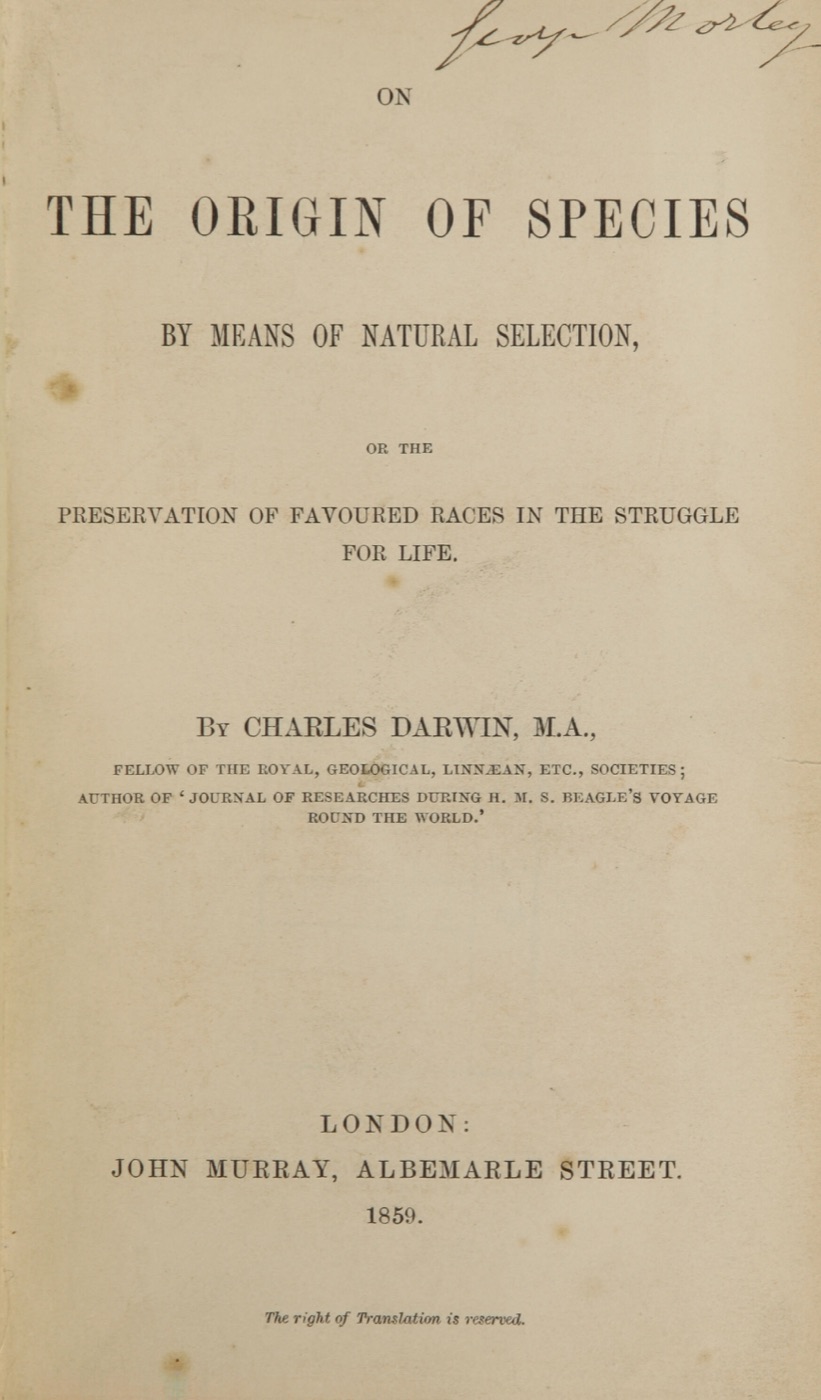
R. B. Freeman, who listed all of Darwin's books, says it came out on 24 November 1859 and that 1,250 copies were printed. He doubts the story that they all sold on the first day. He traces it to Darwin's diary.
Wellcome Collection says this copy has a misprint on page 20, “speceies”, and a publisher's list dated June 1859. Its record says these are thought to mark the earliest issue. Freeman disagrees. He says there was only one issue, and the misprint is not needed to know a first edition.
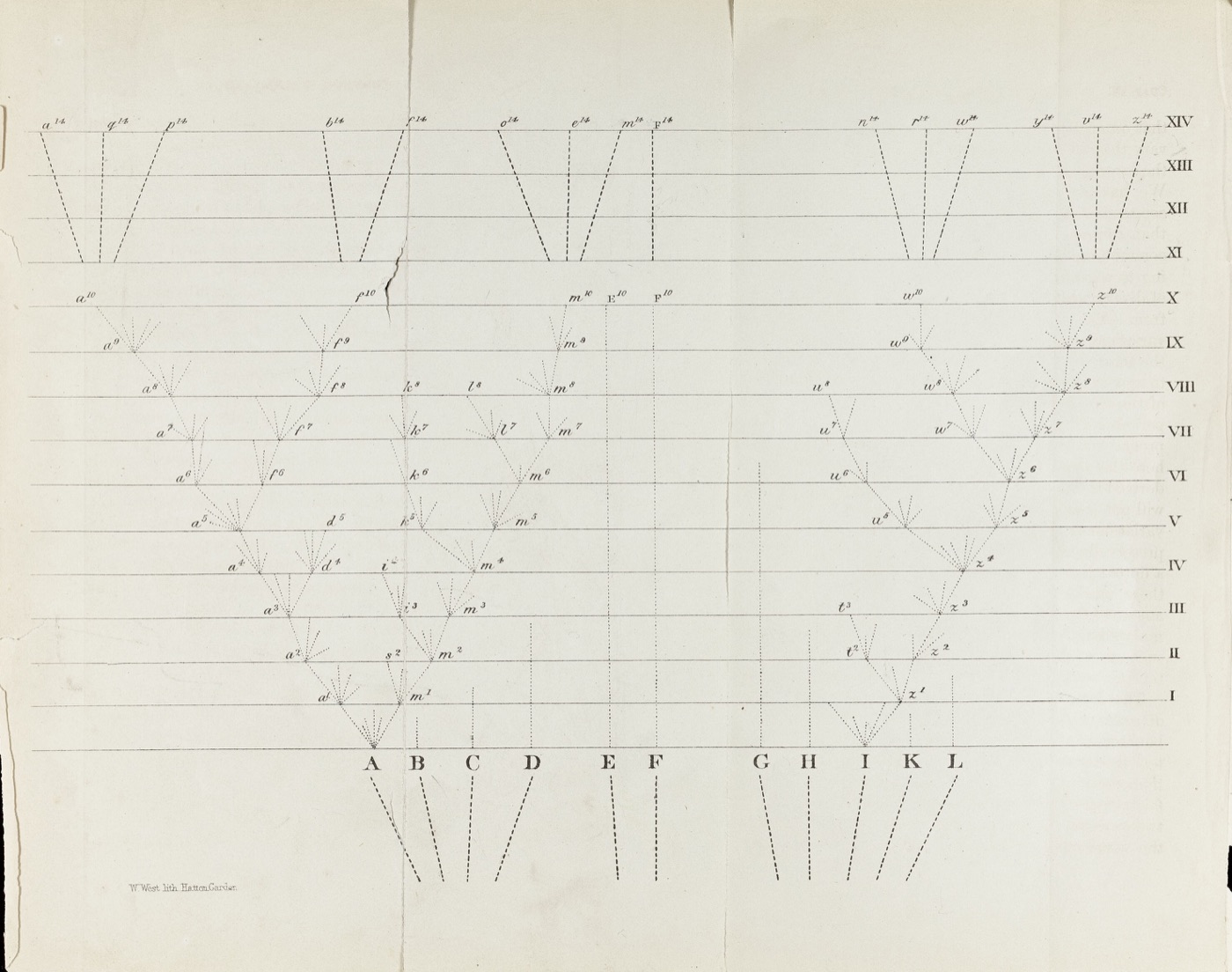
“The accompanying diagram will aid us in understanding this rather perplexing subject.”
From page 116 of the first printing, 1859.
“The affinities of all the beings of the same class have sometimes been represented by a great tree. I believe this simile largely speaks the truth.”
From page 129.
The letters A to L at the foot stand for the species of one large group. In plain words, from page 116.
John van Wyhe, editor of Darwin Online, says the diagram shows how species can be alike because they come from shared ancestors.
Ross MacFarlane, of Wellcome Collection, traces it back to a small sketch in Darwin's notebook from about July 1837. He writes that it has greatly shaped how scientists draw family trees of living things.
R. B. Freeman notes that it faced page 117, and that it stayed in every later edition.
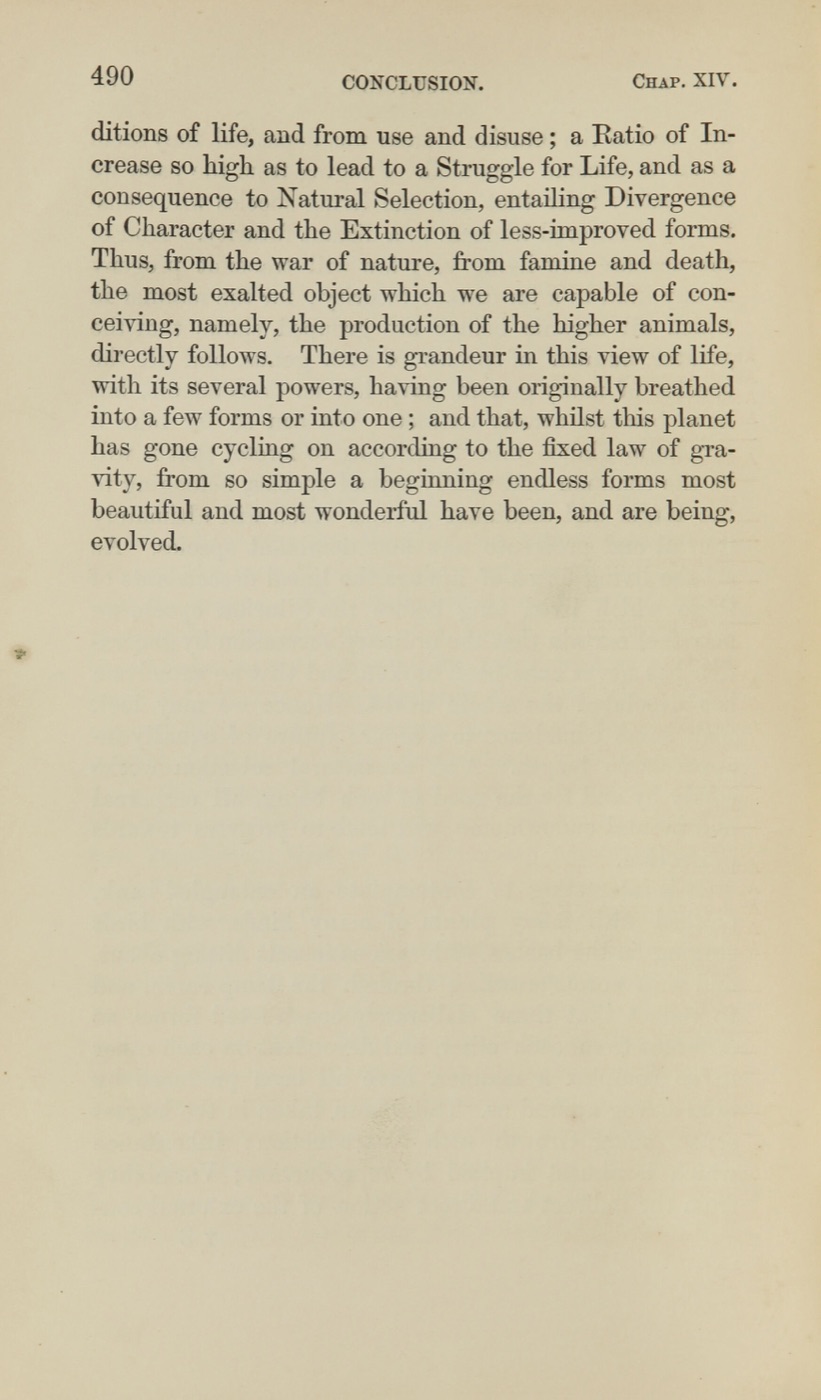
“There is grandeur in this view of life … from so simple a beginning endless forms most beautiful and most wonderful have been, and are being, evolved.”
From page 490 of the first printing, 1859.
R. B. Freeman points out that “evolved” was the last word of the book. Yet the word “evolution” was not used in it until the sixth edition, in 1872.
The part of his mind that went quiet
Late in life, Darwin noticed that poetry, music and pictures, which once gave him enormous pleasure, had stopped reaching him. He thought he knew why, and he wrote down exactly what he would do differently.
The books of Charles Darwin
A careful, anxious naturalist who spent forty years writing books built on mountains of evidence: a voyage diary, the case for evolution, what it means for us, our feelings, earthworms, and a frank memoir for his children.
The letter the day Annie died
The letter Darwin wrote to his wife on the day their daughter Annie died, at ten. Then the same letter in plain words.
The pages he wrote about Annie
A week after his daughter Annie died, Darwin wrote down what she was like, so that he and Emma would not forget. Then the same pages in plain words.
The passage on working as hard as he could
One paragraph from Darwin's autobiography: the sentence he said to himself hundreds of times when he had got something wrong or been mocked. Then the same paragraph in plain words.
Darwin is proof you don't have to be loud to change the world. He was a careful, anxious, almost shy guy who collected evidence obsessively for decades.
On a voyage around the world in his twenties, he noticed how living things varied from place to place. Slowly an idea formed: nature 'selects' — the traits that help you survive get passed on, and over enough time, that builds whole new species.
He took about twenty years to publish it, and historians still argue over why. When he finally published in 1859, it landed like a bomb — because the quiet implication is that humans aren't a separate, special creation. We're part of the same tree as everything else alive.
If you're lost, there's something grounding in that. You're not an accident floating above nature. You're related to all of it — the trees, the animals, the people. You belong here. You came from the same place everything did.
Sources
- Britannica — Charles Darwin
- Darwin Correspondence Project (University of Cambridge)
- Charles Darwin — biography