In the summer of 1889 Vincent van Gogh was 36. Since May he had been a patient at the Saint-Paul hospital in Saint-Rémy, in the south of France. He had chosen to go there. In late June he painted a wheat field near the hospital, with two tall cypress trees at one side. That painting is now in The Metropolitan Museum of Art in New York.
This page starts with what anyone can see in the picture. Then comes what he wrote about it and about its subject, and then how others have read it.
What you are looking at
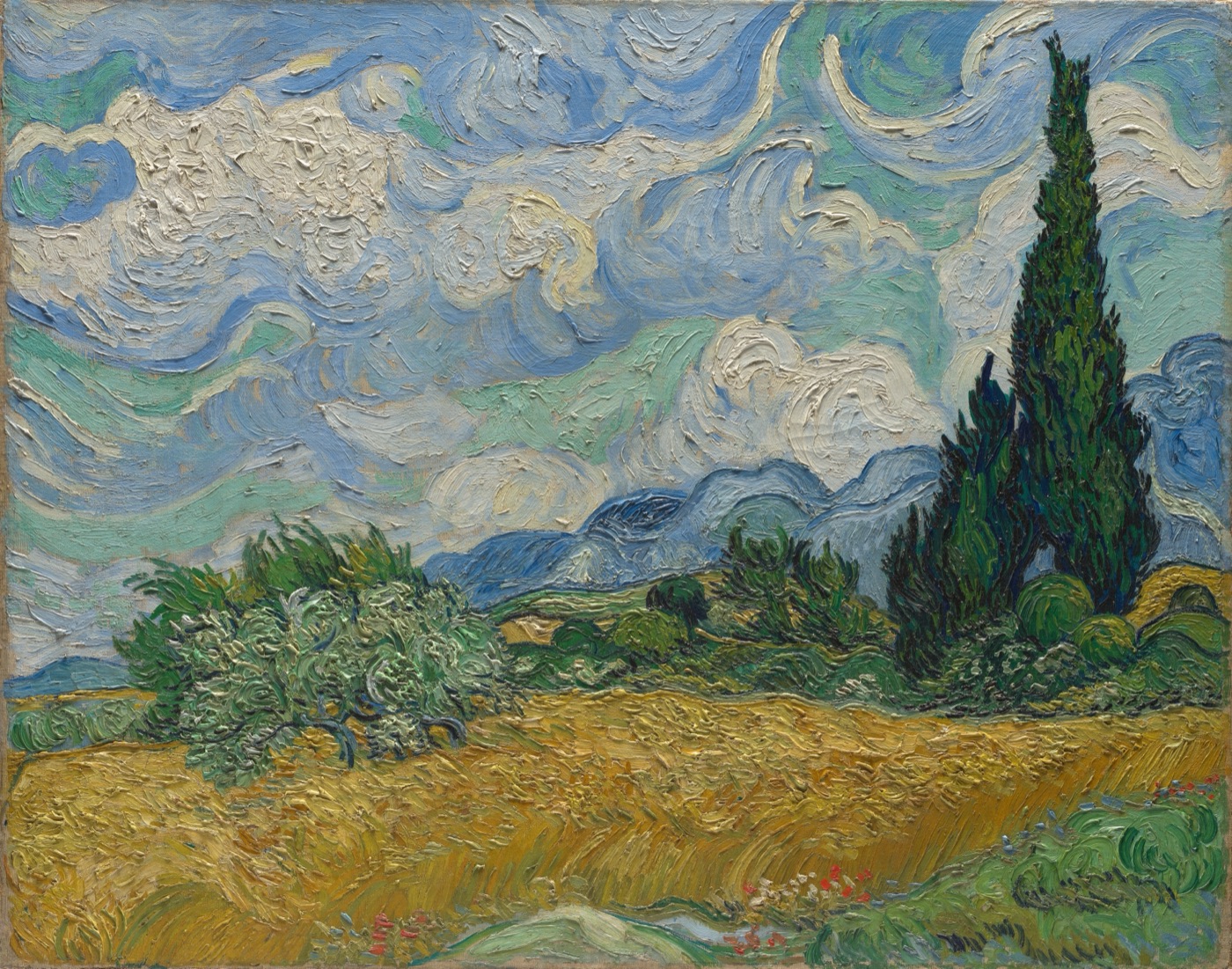
A field of ripe wheat fills the lower part of the picture. It is yellow and gold, with a few small red flowers near the bottom edge.
On the right stand two cypress trees, tall, narrow and dark green. The taller one reaches almost to the top of the canvas. On the left is a round bush of lighter green. Behind the field are more trees and bushes, and behind them a line of low blue hills.
The upper half of the picture is full of cloud. The clouds are white and cream, and they curl against patches of blue and pale green.
The paint is thick. In many places the brushstrokes stand up from the canvas, and you can see which way each one went.
The museum lists the painting as oil on canvas, 73.2 by 93.4 centimetres, about 29 by 37 inches, dated 1889. The National Gallery in London, which owns a later version, says this one was painted on the spot in late June 1889. At that time he could leave the hospital grounds only if a guardian went with him.
What he said about it
From the hospital he wrote often to his brother Theo. For this page, the old English translation of these letters could not be checked against a page scan. So what he told Theo is given here in plain paraphrase, with the date of each letter.
On 25 June 1889 he told Theo he had twelve large canvases under way. The editors of his letters count this picture among them. He wrote that the cypresses were always on his mind. He wanted to do something with them like his paintings of sunflowers, because it surprised him that no one had yet painted them the way he saw them. He said a cypress was as beautiful in its lines and proportions as an Egyptian obelisk. In the same letter he said that a wheat field or a cypress was well worth the effort of looking at closely.
On 2 July he sent Theo about ten drawings of paintings he was working on, so that Theo could see what he was doing. One was a drawing of this picture. It is now in the Van Gogh Museum in Amsterdam.
In that same letter he also wrote about pain. He said that sometimes, from where we stand, it seems to fill the whole horizon. Then he wrote that it is better to look at a wheat field, even one in a painting. On the same day he told his sister that when there are things we cannot understand, we can look at the wheat fields.
In early September he told Theo that some subjects would now come twice: the study, and the final painting. The editors of his letters take this picture to be the study. The final painting, made that month, is the one in London. He also planned smaller paintings of some of his subjects for his mother and his sisters, and the wheat field with cypresses was one of them.
In late November 1889 he wrote to a younger painter, Emile Bernard. He had been ill again and had not written for a long time. This English translation of that letter was printed in 1912. "Corn" is the old British word for grain such as wheat. "By-the-bye" means by the way.
By-the-bye, I am very dissatisfied with this year's work; maybe, however, it will prove a sound foundation for what is to come. I have allowed myself to be completely saturated with the air of the hills and of the orchards; time will show what this has done for me. The whole of my ambition is at present concentrated upon a little handful of earth, sprouting corn, an olive garden, a cypress (the latter, by the way, not easy to paint).
Vincent van Gogh, letter to Emile Bernard, Saint-Rémy, about 26 November 1889. From The Letters of a Post-Impressionist, translated by Anthony M. Ludovici (Constable, London, 1912), page 113. Part of a longer paragraph in a longer letter.
How it has been read
His brother Theo. Theo saw the drawing before he saw the painting. On 16 July 1889 he wrote that some of the drawings were really beautiful. Of the newest ones, he said they looked as if they had been made in a fury, and were a little further from nature. He added that he would understand them better once he saw them as paintings. The Van Gogh Museum, which owns the drawing of this picture, says it was one of those newest drawings. It also points out that the cypress in the drawing was made with a thicker pen than the rest, so it stands out.
The National Gallery, London. The museum that owns the September version calls the New York picture the first version, painted on the spot as a first impression. It calls its own the finished picture, painted in his room after a relapse. It describes the London picture as more stylised, with thinner paint. It reads the mistral, the strong wind of the south of France, as moving through everything here: the wheat, the trees, the clouds and the hills. It sees the swirling lines as showing how alive nature is. It also notes that, for Van Gogh, wheat from sowing to harvest stood for the course of a human life, an idea that comes from a parable in the Bible.
Where they differ. Theo found the newest drawings a little further from nature. The National Gallery stresses that the first painting was made outdoors, in front of the field. Theo was looking at a drawing made from the painting, a few weeks after it was made. The National Gallery is describing the painting itself, and how it was made.
If any of this is close to home and you are struggling to stay safe, you can call or text 9-8-8, any time, in Canada or the US. If you are in danger right now, call 9-1-1.