“I am naturally anti-slavery. If slavery is not wrong, nothing is wrong. I can not remember when I did not so think, and feel.”
From his letter to Albert G. Hodges, 4 April 1864. Checked against his letter at the Library of Congress.
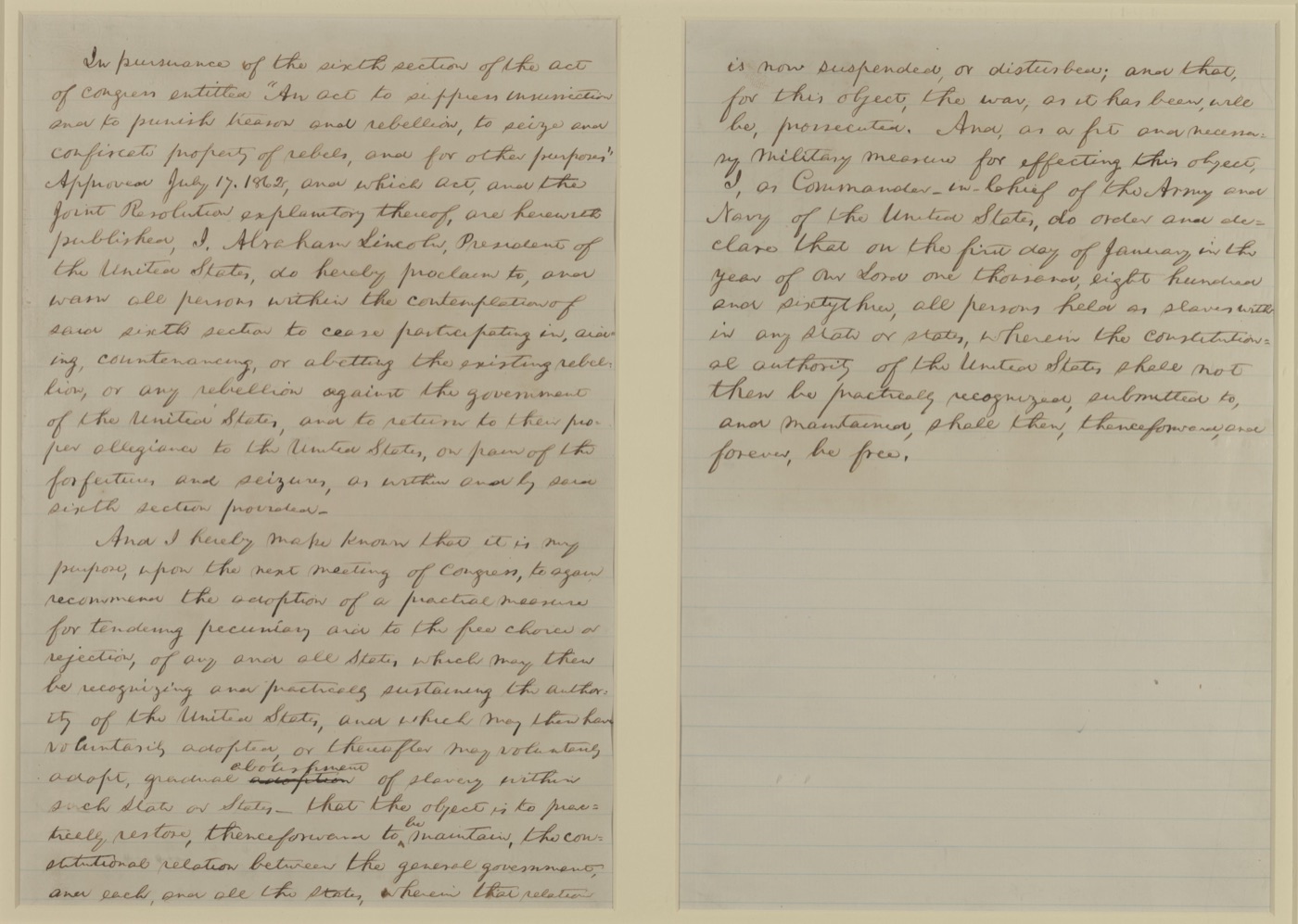
Later he wrote on this draft that it was the proclamation as he first sketched it and showed it to the cabinet. In plain words, from his note on the document.
The Library of Congress, which holds it, calls it his first written sign that he would use his power as commander-in-chief to free enslaved people as a war measure.
The Library also says the cabinet was divided. William Seward, the secretary of state, seems to have persuaded him to wait for a Union victory. A longer proclamation was made public in September 1862, after the Battle of Antietam.
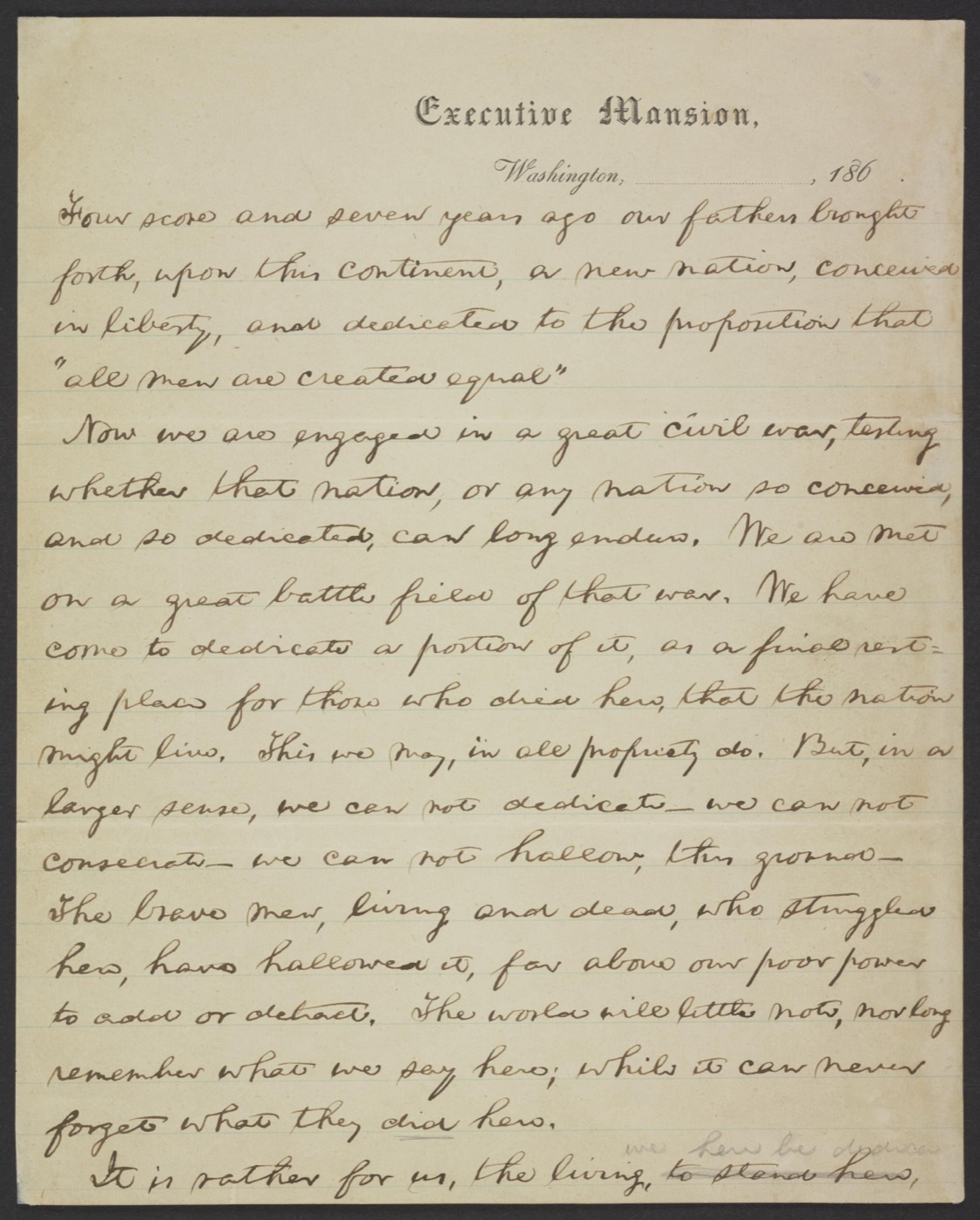
The day after the speech, he wrote to Edward Everett, the main speaker that day. He said he was glad that, in Everett's view, the little he had said was not entirely a failure. In plain words, from his letter of 20 November 1863.
Edward Everett had spoken for two hours. He wrote to Lincoln that Lincoln had come nearer to the heart of the occasion in two minutes.
The Library of Congress says five copies in his hand survive, and at least one was written before the speech. His secretary John Nicolay, who owned this one, believed it was the copy Lincoln held that day.
Not everyone agrees. The Library, citing the historian Garry Wills, doubts that the two pages come from the same draft.
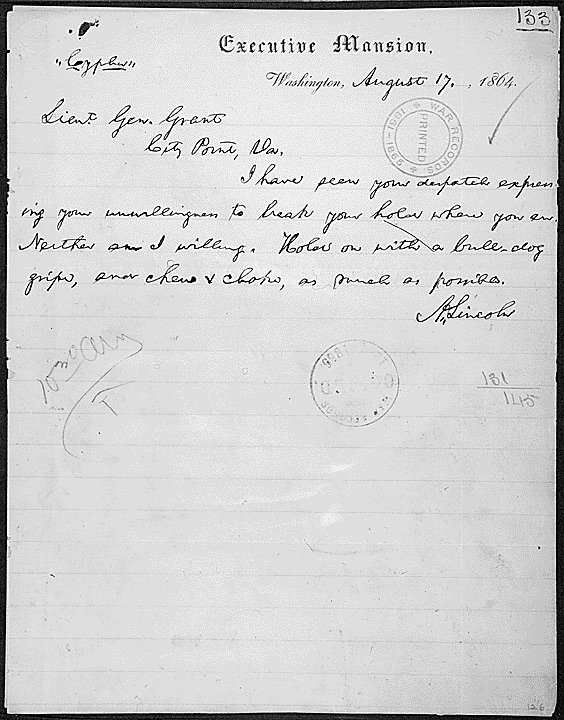
“Hold on with a bull-dog grip, and chew & choke, as much as possible.”
The end of the message, as written on this page.
Horace Porter, an officer on Grant's staff, watched Grant read it. Grant laughed and said, “The President has more nerve than any of his advisers.”
Porter explains why. General Henry Halleck had warned that troops might be needed at home to enforce the draft. Grant had answered that he would not let go where he was.
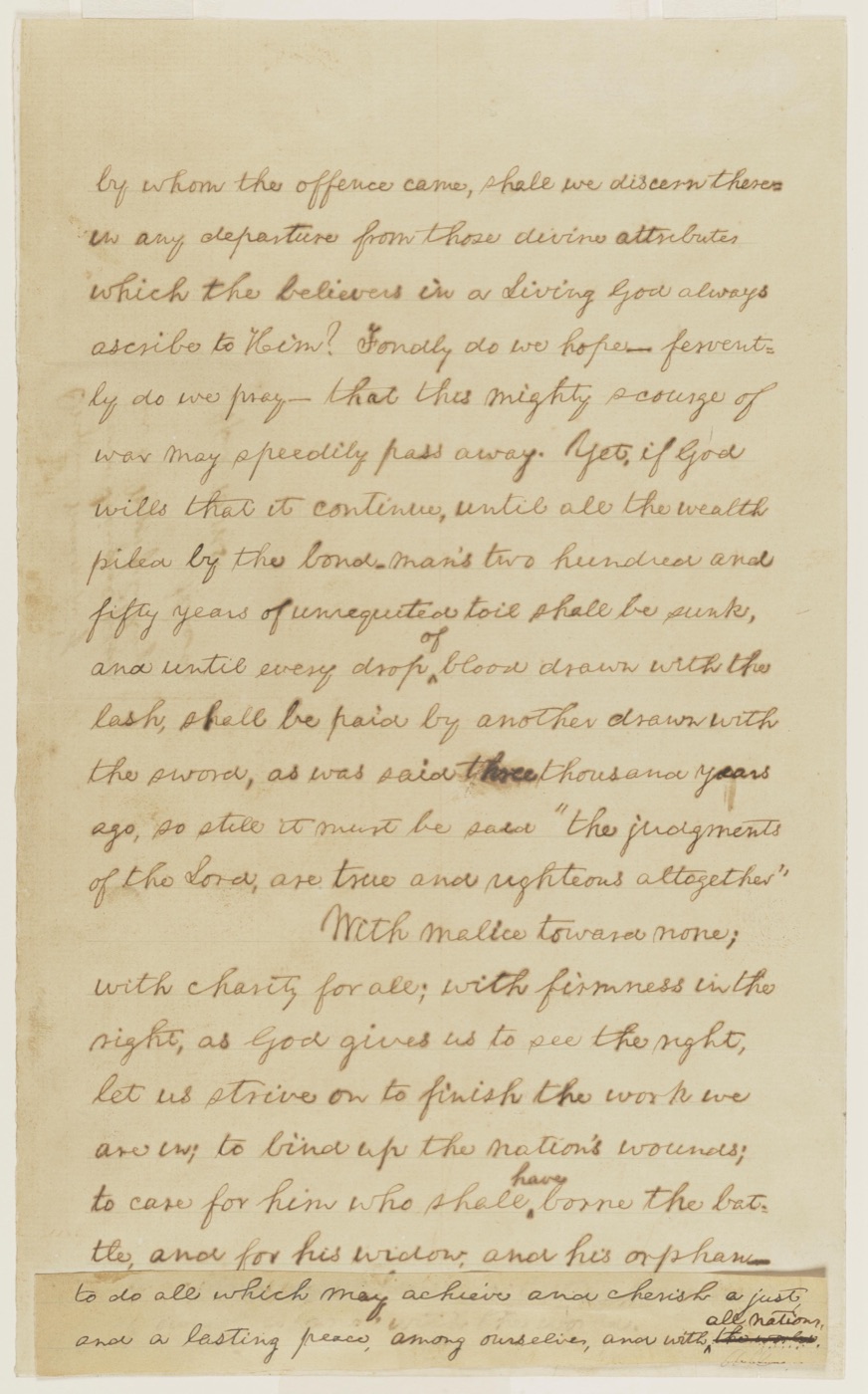
“I expect the latter to wear as well as—perhaps better than—any thing I have produced; but I believe it is not immediately popular.”
From his letter to Thurlow Weed, 15 March 1865, thanking him for his praise of the address. Checked against the letter at the Shapell Manuscript Foundation.
The Library of Congress says this is a clean copy, written large, as if to be read aloud. On the day, he seems to have read from a printed version made from it.
Frederick Douglass was in the crowd that day. That evening at the White House, Lincoln asked him what he thought. Douglass answered that it was “a sacred effort.”
The most miserable man living
In January 1841, Abraham Lincoln wrote that he was the most miserable man living. The darkness stayed with him, and he built a life of purpose around it, not instead of it.
You are sure to be happy again
Ten months after his own son died, the president wrote to a young woman whose father had just been killed in the war. What he told her about grief, and why he could say it.
The letter about forebodings
A letter he wrote in February 1842 to his closest friend, Joshua Speed, shown whole from the manuscript: one anxious man telling another that their fears had been wrong. Then the same letter in plain words.
The letter about the gem he lost
Part of a letter he wrote to Joshua Speed in July 1842, shown as he wrote it: he says he has lost his trust in himself and not yet got it back. Then the same lines in plain words.
The letter about his dying father
The letter he wrote to his stepbrother in January 1851, when he heard his father was dying, shown whole from the manuscript: why he had not written, and why he was not coming. Then the same letter in plain words.
The books of Abraham Lincoln
Lincoln never wrote a book in the usual sense. He left speeches, debates and letters. This is a guide to the editions of his writing, and to one modern book about how he lived with a recurring darkness.
If any of this is close to home and you are struggling to stay safe, you can call or text 9-8-8, any time, in Canada or the US. If you are in danger right now, call 9-1-1.